


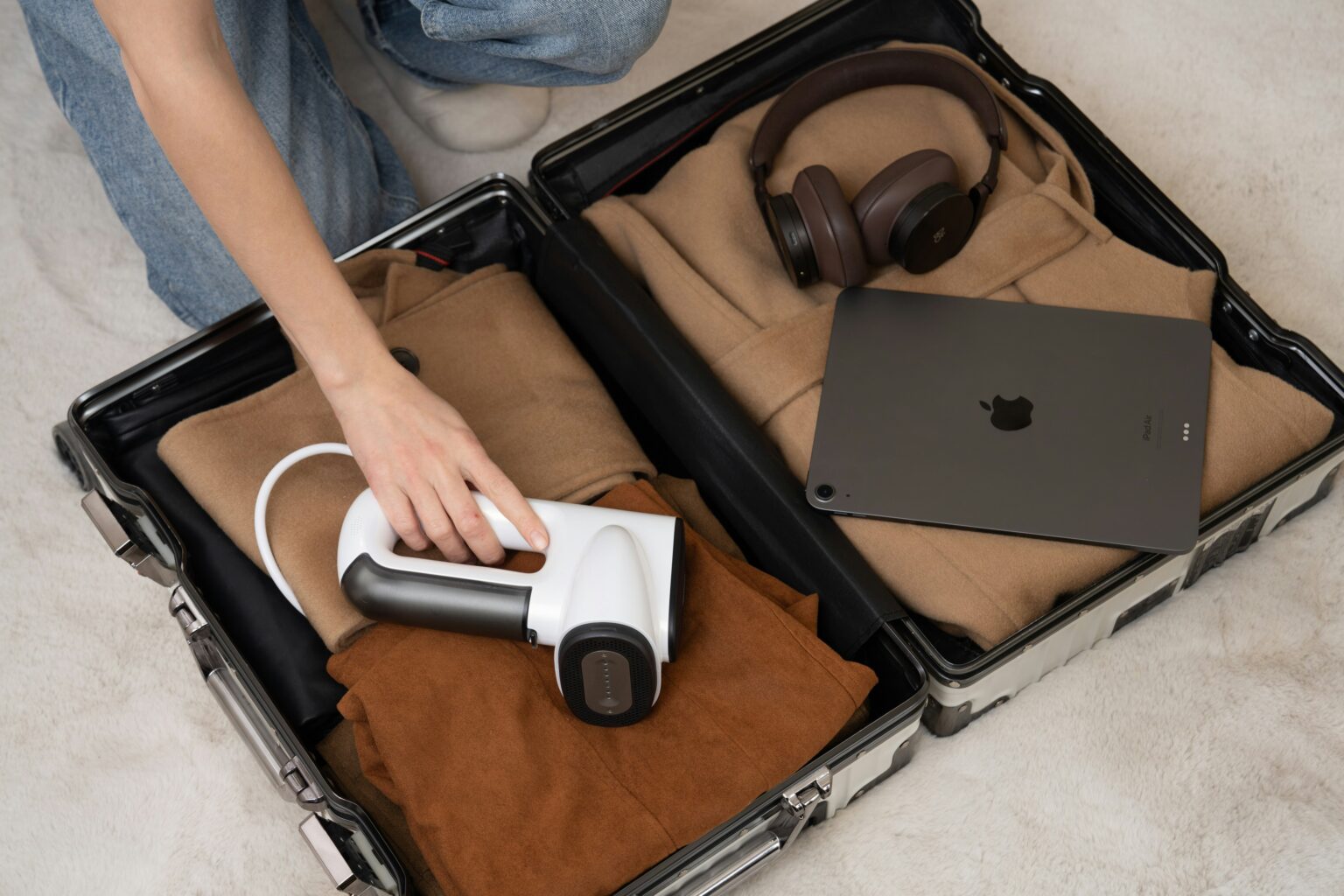
A good travel steamer is a small, lightweight device that removes wrinkles from clothes without an ironing board. Most models heat water into steam and release it through a handheld head you glide over fabric. They’re small enough for a carry-on and work on most clothing types. Below, we cover how to pick one, what to look for, and how to fly with it without any airport hassle.
Why Travelers Use a Travel Steamer
A travel steamer solves one simple problem. Clothes get wrinkled in a suitcase, and hotel irons are not always available or clean.
Here’s what a travel steamer gives you:
- No ironing board needed
- Works on hanging clothes, so you skip the iron-and-board setup
- Gentler on delicate fabric than a hot iron
- Small enough to fit in a carry-on bag
If you travel often for work, weddings, or long trips, this small tool saves real time.
Types of Travel Steamers
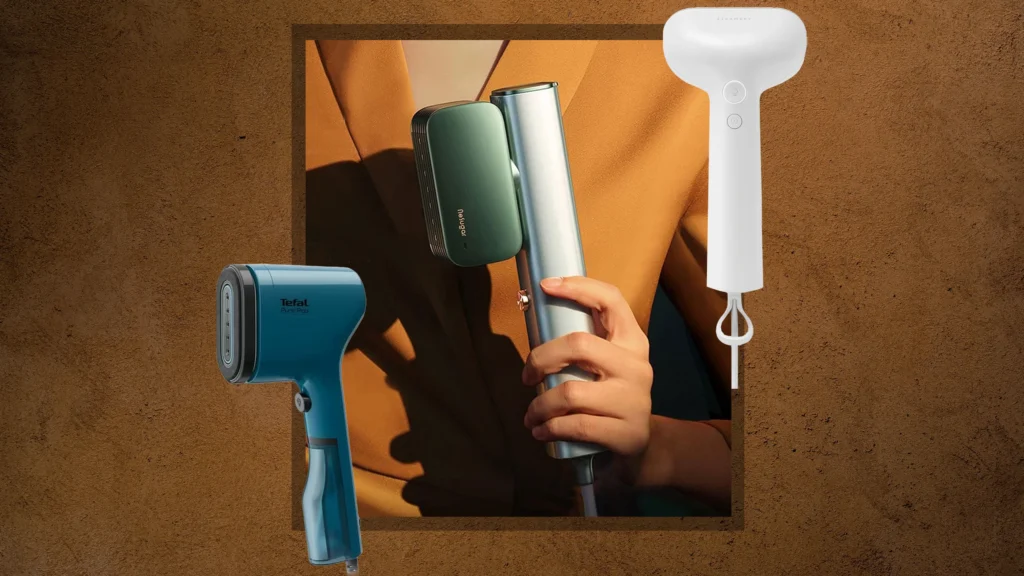
Handheld Steamers
These are the smallest and lightest option. You hold the device directly against your clothes. Good for quick touch-ups on shirts, dresses, and jackets.
Compact Upright Steamers
These have a small base with a hose and steam head. They hold a bit more water than handheld models, so they run longer. Slightly bigger, but still travel-friendly.
Dual-Voltage Steamers
If you travel internationally often, look for a dual-voltage model. These work on both 120V (used in the US) and 220-240V (used in Europe, Asia, and much of the world). Without dual voltage, your steamer may not work correctly abroad, or it could get damaged.
How to Choose the Best Travel Steamer
1. Check the Weight and Size First
Travel steamers usually range from very light handheld models to slightly larger compact units. If you’re tight on luggage space, go handheld. If you steam clothes often and don’t mind a bit more bulk, a compact upright model works better.
2. Look at Heat-Up Time
Most travel steamers heat up in under a minute. If you’re often steaming clothes minutes before heading out the door, a fast heat-up time matters more than you’d think.
3. Check the Water Tank Size
A smaller tank means less steaming time before refilling. This is fine for one or two garments. If you plan to steam multiple outfits in one go, look for a slightly bigger tank.
4. Confirm Fabric Compatibility
Most steamers work on cotton, linen, wool, polyester, and silk. Always check the manual for delicate fabrics like silk or fine wool, since too much direct steam can damage certain weaves.
5. Decide Between Corded and Battery-Powered
Corded steamers are simple and reliable. Battery-powered or cordless models are more portable, but they come with extra airline battery rules, which we cover next.
Can You Bring a Travel Steamer on a Plane?
Yes, you can bring a travel steamer on a plane, in both carry-on and checked luggage. This applies to standard corded models used by most travelers.
A few things to know before you fly:
- Empty the water tank completely. TSA’s liquid rules apply to any water left inside, so travel with it dry.
- Let it cool and dry before packing. A damp or warm steamer can raise questions at the screening checkpoint.
- Pack it where it’s easy to identify. Keep it near other small electronics, not buried under clothes, so screening goes faster.
- Battery-powered models need extra care. If your steamer has a rechargeable battery, it needs to follow standard airline lithium battery rules. Devices under 100 watt-hours are typically fine; anything higher may need airline approval.
- Check voltage for international trips. If you’re flying abroad, confirm your steamer works with the outlet voltage at your destination.
Carry-on is usually the safer choice, especially for models with glass or fragile parts. It also means your steamer is with you if your checked bag is delayed.
How to Pack a Travel Steamer Without Damage
- Wrap the steamer head or plate in a soft cloth or pouch
- Coil the cord loosely instead of bending it sharply
- Keep it away from laptops, chargers, or anything sensitive to moisture
- Place it in the middle of your bag, surrounded by soft clothing, if checking it
This keeps the steamer safe and avoids any surprise leaks near your other items.
Our Take: Which Type Should You Buy?
If you travel light and just need quick touch-ups, a handheld steamer is the easiest choice. It’s the smallest, cheapest, and fastest to pack.
If you travel for work or events often and need to steam full outfits regularly, a compact upright model is worth the extra size. And if international travel is part of your routine, make dual voltage a non-negotiable feature.
Whatever you pick, remember the real value is not just removing wrinkles. It’s skipping the hunt for a working hotel iron every time you land.
FAQ
Is a travel steamer allowed in carry-on luggage? Yes. A standard travel steamer is allowed in carry-on bags as long as the water tank is completely empty before you reach security.
Do I need a dual-voltage travel steamer? Only if you travel internationally. US outlets run on 120V, while many other countries use 220-240V. A dual-voltage steamer works safely in both without needing a separate converter.
Can a travel steamer damage certain fabrics? Yes, in some cases. Delicate fabrics like fine silk or certain synthetic blends can be affected by direct, prolonged steam. Always check the fabric care label and hold the steamer a few inches away from delicate material.
Is a travel steamer better than a hotel iron? It depends on your priorities. A travel steamer is faster, gentler on fabric, and doesn’t need an ironing board. A hotel iron may give sharper creases on stiff fabrics like dress shirts, but availability and cleanliness vary by hotel.