


Yes, you can generally take a CPAP machine on Airplane flights. CPAP machines are recognized as assistive devices under U.S. Department of Transportation rules, and passengers can generally bring them into the aircraft cabin. They do not count toward the airline’s normal carry-on baggage limit under applicable U.S. rules.
If you use CPAP therapy every night, you do not need to leave your machine at home when traveling. However, CPAP TSA rules, airline procedures, battery requirements, and rules for using the machine during the flight are important to understand before you travel.
This guide explains how to pack your CPAP, what to expect at airport security, how batteries work, and what to know when traveling with a CPAP Machine on an Airline.
Is a CPAP Machine on an Airplane Allowed?
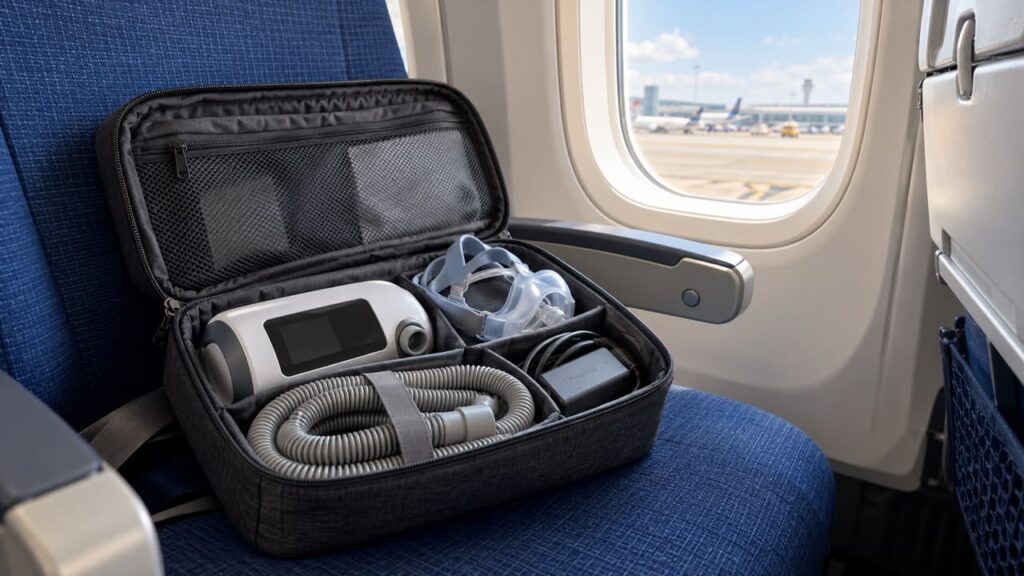
Yes. CPAP machines are specifically listed as assistive devices by the U.S. Department of Transportation (DOT). They may be carried in the passenger cabin and can generally be stored under the seat, in an overhead compartment, or in another approved storage area if the device fits safely.
One important advantage is that an assistive device such as a CPAP generally does not count toward your standard carry-on baggage allowance under U.S. DOT rules.
That means you can usually bring your CPAP separately rather than having to fit the machine into your regular carry-on luggage.
Quick CPAP Machine on an Airplane Guide
| Question | General Answer |
|---|---|
| Can you take a CPAP on an airplane? | Yes |
| Can you bring it in the cabin? | Yes |
| Does it count as a normal carry-on? | Generally no under U.S. DOT rules |
| Can you put it under the seat? | If it fits safely |
| Can it go in an overhead compartment? | Yes, if permitted and space is available |
| Can you use it during flight? | Often, subject to airline requirements |
| Should you check it as baggage? | Carrying it in the cabin is generally preferable |
| Can you bring a backup battery? | Yes, subject to battery rules |
| Should you check airline requirements? | Yes, especially for international travel |
What Are the CPAP TSA Rules?
For travelers departing from U.S. airports, TSA screens CPAP machines as part of the airport security process. TSA’s general guidance notes that items can receive additional screening if they trigger an alarm or require further inspection.
Because airport security procedures can change, check TSA’s current guidance before your trip.
When going through security, keep your CPAP easily accessible. You may need to remove the machine from its travel bag for screening depending on the airport and screening procedure.
Do You Need to Remove the CPAP From Its Bag?
Security screening procedures can vary. A CPAP may receive additional screening, so keeping the machine accessible can make the process easier.
A practical approach is to:
- Keep the CPAP in its dedicated travel case.
- Avoid burying it underneath clothes.
- Follow the instructions from the TSA officer.
- Allow additional time if the device needs inspection.
- Repack the machine carefully after screening.
Do not assume that every airport will handle the machine in exactly the same way.
Should You Carry Your CPAP or Check It?
For most travelers, carrying your CPAP in the cabin is the more practical approach.
A CPAP is a medical assistive device, and U.S. DOT rules provide cabin-stowage protections for assistive devices.
Checking your CPAP also creates the possibility that your checked baggage could be delayed or lost while you arrive without the equipment you need.
Why Keep Your CPAP With You?
There are several practical reasons:
- You have access to the machine during the journey.
- You reduce the risk of separation from your equipment.
- You can use it if an overnight delay occurs.
- You can protect the machine from rough baggage handling.
- You can keep accessories together.
If your CPAP is considered an assistive device for your trip, tell the airline staff if you need assistance with its stowage.
Can You Use a CPAP Machine on an Airplane?
You may be able to use a CPAP during a flight, but flying with a CPAP machine is not the same as simply carrying one onboard.
The U.S. DOT states that CPAP machines are permitted on flights, but airlines may have requirements for passengers who want to use a CPAP during the flight. These can include advance notification, documentation in certain circumstances, battery requirements, and earlier check-in.
Therefore, if you plan to sleep during a long flight and want to use your machine, contact your airline before traveling.
Check With Your Airline Before the Flight
Ask the airline:
- Whether your specific CPAP model can be used onboard.
- Whether advance notification is required.
- Whether a medical certificate is needed.
- Whether the aircraft has an appropriate power outlet.
- Whether you need a battery.
- Where the machine can be stored during takeoff and landing.
This is particularly important when traveling internationally because airline and foreign aviation requirements can differ.
What About CPAP Batteries on a Plane?
A backup battery can be useful if you are traveling with a CPAP machine on an airline, especially if you cannot rely on an aircraft power outlet.
Battery rules depend on the battery type and capacity.
The FAA states that rechargeable lithium-ion batteries with a capacity of 0–100 Wh are generally permitted on passenger aircraft. Batteries between 101 and 160 Wh require airline approval, while lithium-ion batteries above 160 Wh are generally not permitted for passenger air travel. Spare lithium batteries must be carried in the cabin rather than checked baggage.
Check Your Battery’s Watt-Hour Rating
Do not guess whether your CPAP battery is permitted.
Look for the Wh rating on the battery or manufacturer’s specifications. If the rating is not obvious, contact the manufacturer or airline before traveling.
Also protect spare batteries from short circuits and physical damage. FAA guidance requires spare lithium batteries to be carried in carry-on baggage.
How Much Battery Power Do You Need?
If you plan to operate your CPAP during a flight using a battery, calculate your expected usage before leaving home.
The DOT guidance for CPAP use states that an airline may require passengers using a CPAP onboard to bring fully charged batteries capable of powering the device for at least 150% of the flight duration.
For example, if your flight lasts 8 hours, the relevant requirement would mean having enough battery capacity for at least 12 hours if your airline applies that requirement.
Your actual CPAP battery life can vary depending on the machine, pressure settings, humidifier, heated tubing, and battery model. Follow the battery manufacturer’s specifications rather than assuming a particular number of hours.
Should You Use the Humidifier During a Flight?
A CPAP humidifier can significantly increase power consumption.
If you are using a battery during travel, check whether your machine allows you to disable the heated humidifier and heated tubing. Some travelers choose not to use heated features when running from a battery because they can reduce operating time.
However, your CPAP manufacturer’s instructions should always take priority.
If you normally rely on humidification for comfortable therapy, plan your power needs accordingly.
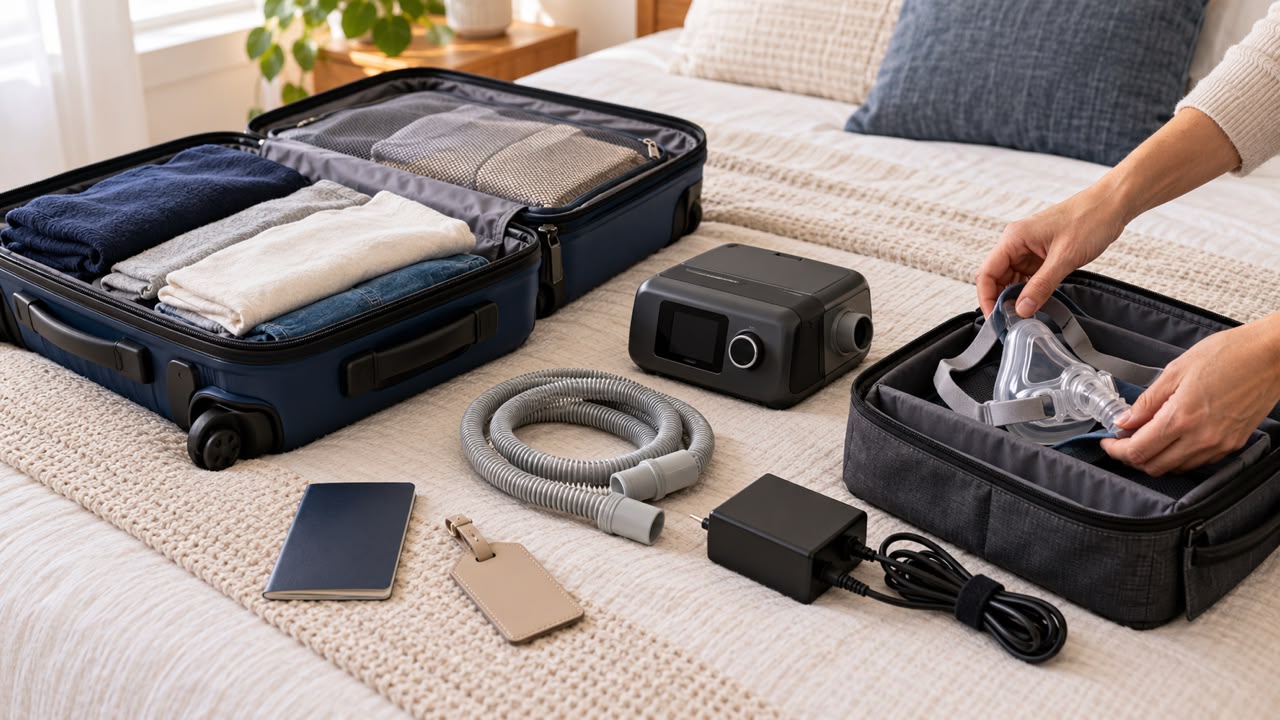
How to Pack a CPAP Machine on an Airplane Travel
Good packing can make flying with a CPAP machine much easier.
Use the Original or a Dedicated Travel Case
Keep the CPAP machine, mask, tubing, power supply, and accessories together in a protective case.
Avoid placing the machine loose inside a suitcase where it could be damaged.
Pack Your Accessories
Before leaving, check that you have:
- CPAP machine
- Mask
- Tubing
- Power adapter
- Power cord
- Filters
- Battery, if needed
- Manufacturer-approved accessories
- Travel case
If you use a humidifier, make sure the water chamber is empty and dry before packing.
Keep the CPAP Accessible
If you are carrying the machine through airport security, placing it somewhere easy to reach can save time.
Keep important accessories together rather than distributing them among several bags.
Can You Bring CPAP Water Through Airport Security?
If your CPAP uses a humidifier, you may need distilled or purified water at your destination.
Do not assume you can take a large container of water through airport security simply because it is intended for your CPAP. TSA liquid restrictions can apply to liquids carried through security.
A simpler option is often to travel with an empty water chamber and obtain suitable water after passing through security.
Check the manufacturer’s instructions for the appropriate water type for your machine.
CPAP Travel Tips for Long Flights
Long flights require a little more preparation.
1. Keep the Machine in Your Cabin
Avoid unnecessary checked baggage for your CPAP when possible.
2. Charge Your Battery Before Leaving
If you use a backup battery, fully charge it before heading to the airport.
3. Check the Airline’s CPAP Policy
Do this before your departure date, particularly if you plan to use the machine during the flight.
4. Bring Your Power Adapter
Do not assume that an airplane seat will have the right type of power connection.
5. Carry Essential Accessories
A missing mask, hose, or power adapter can make the machine difficult or impossible to use.
6. Allow Extra Time at Security
Additional screening may take time, so avoid arriving at the airport at the last minute.
7. Check Your Destination
If traveling internationally, verify the power requirements at your destination. You may need a plug adapter, and in some cases a voltage-conversion solution may be relevant depending on your equipment.
CPAP Travel Checklist
Use this checklist before leaving for the airport:
CPAP Equipment
- CPAP machine
- Mask
- Tubing
- Power supply
- Power cord
- Filters
- Water chamber, if applicable
- Travel case
Travel Preparation
- Check airline CPAP policy
- Check battery requirements
- Fully charge backup battery
- Check battery Wh rating
- Pack CPAP in cabin baggage
- Check destination power requirements
- Keep machine accessible for security screening
Frequently Asked Questions
Can I take a CPAP on an airplane?
Yes. CPAP machines are recognized as assistive devices under U.S. DOT rules and are permitted on flights. They can generally be carried in the cabin and do not count toward the standard carry-on limit under applicable U.S. rules.
Does a CPAP machine count as a carry-on bag?
Under U.S. DOT rules, assistive devices such as CPAP machines do not count toward an airline’s carry-on baggage limit. However, you should still check your airline’s procedures for how the device must be stored onboard.
Can I use my CPAP during a flight?
CPAP use during a flight can be permitted, but airlines may have specific requirements. These can include advance notice, documentation in certain situations, and adequate battery power. Contact your airline before the flight if you plan to use your CPAP onboard.
Do CPAP machines have to go through TSA screening?
Yes. CPAP equipment is subject to airport security screening. TSA may require additional screening depending on the circumstances. Follow the instructions of the TSA officer at the checkpoint.
Can I bring a CPAP battery on an airplane?
Yes, subject to applicable battery restrictions. FAA rules generally allow rechargeable lithium-ion batteries up to 100 Wh, while batteries from 101–160 Wh require airline approval. Spare lithium batteries must remain in carry-on baggage.
Should I put my CPAP in checked luggage?
You can discuss baggage arrangements with your airline, but keeping your CPAP with you in the cabin can reduce the risk of being separated from an important medical device. U.S. DOT rules specifically recognize CPAP machines as assistive devices permitted in the cabin.
Conclusion
A CPAP on airplane travel is generally allowed, and U.S. transportation rules specifically recognize CPAP machines as assistive devices. You can generally carry the machine in the cabin without having it count toward your standard carry-on allowance under applicable U.S. rules.
The most important steps are to keep your CPAP protected and accessible, prepare for airport security screening, check your airline’s requirements, and understand the battery rules if you plan to use a portable power source.
If you intend to use your CPAP while flying, contact your airline before departure. Requirements can vary, and some airlines may require advance notice or additional documentation. With the right preparation, traveling with a CPAP machine on an airline can be a straightforward part of your trip.