


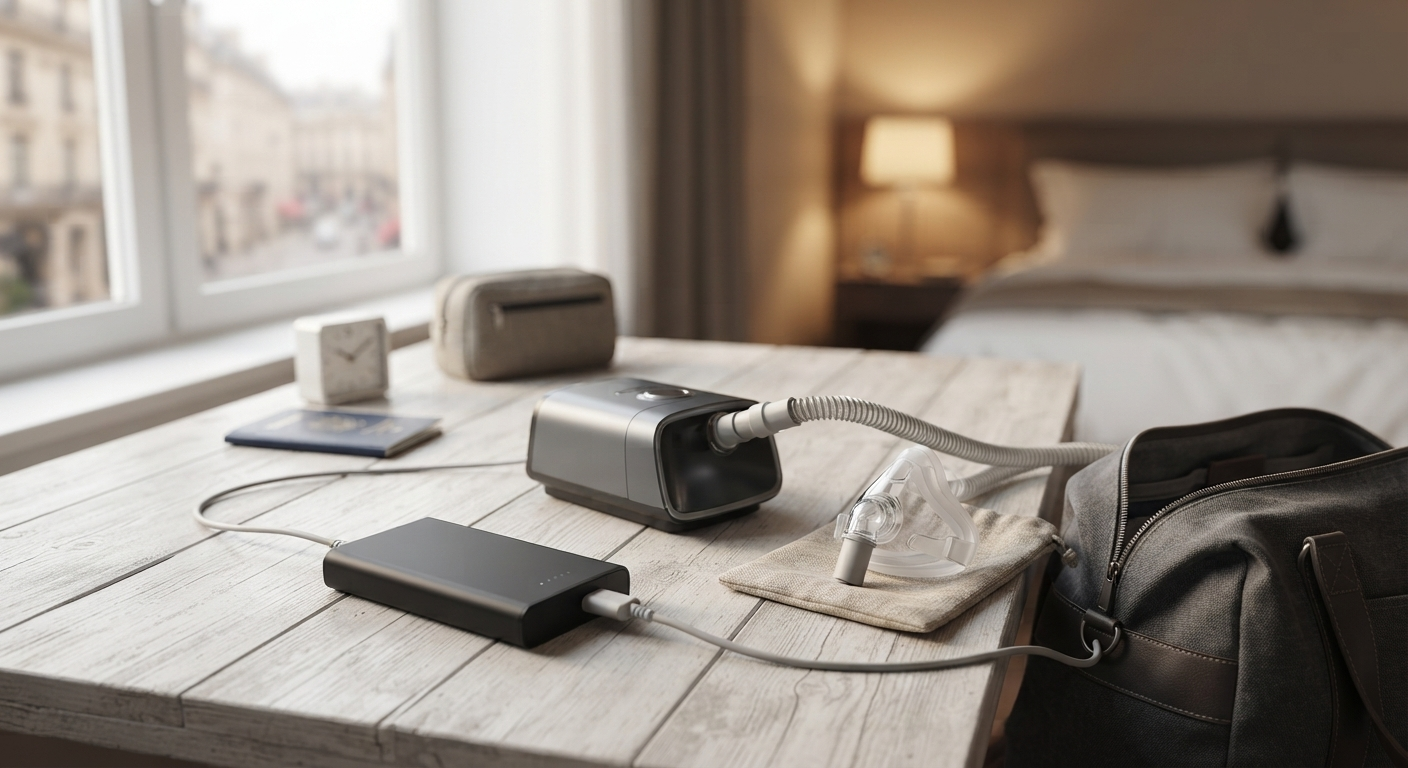
A CPAP travel battery can be an important part of your travel setup when you sleep with a CPAP machine and cannot rely on a standard wall outlet. Whether you are going camping, taking a road trip, staying somewhere with unreliable electricity, or preparing for a power outage, having a dependable backup power source can help you continue your normal CPAP therapy.
The right battery depends on several factors, including your CPAP machine, therapy settings, humidifier use, trip length, and whether you need power for a few hours or multiple nights.
This guide explains what to look for in a portable CPAP battery, how CPAP batteries work, what to consider for camping and air travel, and how to choose the right option for your needs.
What Is a CPAP Travel Battery?
A CPAP travel battery is a rechargeable power source designed to operate a CPAP machine when regular electrical power is unavailable.
Instead of connecting your CPAP directly to a wall outlet, you connect the machine to the battery using a compatible cable, adapter, or power supply.
A good battery can be useful for:
- Camping trips
- Road trips
- Flights and travel
- Emergency power outages
- Remote locations
- Overnight stays without reliable electricity
- Backup power at home
Not every CPAP machine uses power in exactly the same way. Therefore, battery compatibility should always be checked before purchasing.
Why Do You Need a Portable CPAP Battery?
Traveling with CPAP equipment can be challenging when electricity is not guaranteed.
A portable CPAP battery gives you another power option when a wall outlet is unavailable. This can be especially useful during outdoor trips or unexpected power failures.
CPAP Battery for Camping
Camping is one of the most common situations where a battery can be useful.
A campsite may not have an electrical hookup, or you may prefer to sleep away from powered campsites. A suitable CPAP battery for camping allows you to run your machine without depending on campground electricity.
For camping, look for a battery that is:
- Portable enough to carry comfortably
- Large enough for your required runtime
- Compatible with your CPAP machine
- Rechargeable
- Protected against short circuits and overheating
- Easy to recharge before the next night
If you use a humidifier or heated tubing, remember that these features can significantly increase power consumption.
How Long Can a CPAP Battery Last?
There is no single runtime that applies to every CPAP machine and battery.
Battery runtime depends on:
- Battery capacity
- CPAP model
- Pressure settings
- Humidifier use
- Heated tubing
- Ambient temperature
- Battery efficiency
- Other accessories connected to the machine
A battery with a higher capacity generally provides more available energy, but the actual runtime can vary.
For example, a CPAP setup using a humidifier may consume considerably more power than the same machine operating without heated features.
Check Watt-Hours
When comparing batteries, look for the watt-hour (Wh) rating.
Watt-hours provide a useful way to compare the energy capacity of different batteries.
The basic calculation is:
Watt-hours = Volts × Amp-hours
For example, a 12-volt battery rated at 8 Ah has a nominal capacity of 96 Wh. The FAA also uses this calculation when explaining how travelers can determine a lithium battery’s watt-hour rating.
However, the battery’s stated capacity does not mean all of that energy will necessarily reach your CPAP machine. Power conversion and the CPAP’s own electrical requirements can affect actual runtime.
CPAP Power Options for Travel
There are several ways to power a CPAP machine while traveling.
| Power Option | Best For | Main Advantage | Limitation |
|---|---|---|---|
| CPAP Travel Battery | Camping and backup | Portable | Limited runtime |
| AC Wall Power | Hotels and homes | Simple and reliable | Requires outlet |
| Vehicle Power | Road trips | Can use vehicle power | Requires compatible setup |
| Portable Power Station | Camping and extended trips | Higher capacity | Larger and heavier |
| Airline-Approved Battery | Flights | Portable backup | Must meet airline rules |
| Solar Charging Setup | Remote camping | Can recharge away from outlets | Depends on sunlight |
The best option depends on your destination and how long you need to operate your machine.
How to Choose the Best CPAP Travel Battery
Before buying a battery, consider these important factors.
1. Check CPAP Compatibility
Start by checking your CPAP manufacturer’s power requirements.
Some machines can operate from DC power with a suitable converter, while others require a specific power adapter.
For example, ResMed says the AirMini does not have an internal battery and requires an external power source. ResMed also states that its 65W DC/DC converter can allow the AirMini to operate from a suitable 12V or 24V DC source in a vehicle.
Always check the manufacturer’s instructions for your specific machine before connecting it to a battery.
2. Consider Battery Capacity
Battery capacity is one of the most important specifications.
If you only need a few hours of backup power, a smaller battery may be sufficient. If you need multiple nights away from electricity, you may need a higher-capacity option.
Do not choose a battery based only on physical size. Check its actual Wh rating and compare it with your CPAP’s power requirements.
3. Think About Humidifier Usage
Your CPAP humidifier can use additional electricity.
If you are camping or traveling without easy access to electricity, consider whether you actually need the humidifier and heated tubing.
Some travelers choose to turn off heated features when using battery power to extend runtime, but you should follow your CPAP manufacturer’s instructions and make sure the change remains comfortable and appropriate for your therapy.
4. Check Weight and Size
A large battery may offer more capacity but can be inconvenient to carry.
For flights and backpacking, portability matters. For car camping, a heavier battery may be acceptable because you do not need to carry it long distances.
Think about how you will travel before choosing the battery size.
5. Look at Recharge Options
A battery is only useful if you can recharge it.
Depending on the model, recharge options may include:
- AC wall outlet
- Vehicle outlet
- USB charging
- Solar charging systems
- Compatible portable power stations
For longer trips, consider how you will recharge the battery between nights.
Best CPAP Battery for Camping
The best CPAP battery for camping is not necessarily the largest one.
For a short camping trip, portability and simple charging may be more important than maximum capacity. For several nights without electricity, higher capacity becomes more important.
Short Camping Trips
For a one-night trip, a compact battery may be enough if it is compatible with your CPAP and provides adequate runtime.
Multi-Night Camping
For several nights, consider a larger battery or a setup that allows you to recharge during the day.
A portable power station may be practical for car camping because you can carry more capacity without worrying as much about weight.
Backpacking
Backpackers should prioritize weight.
A lightweight CPAP-compatible battery can be more practical than a large power station. However, you should carefully calculate expected runtime before leaving.
Can You Take a CPAP Battery on an Airplane?
Yes, CPAP batteries can be carried on flights when they meet applicable battery and airline requirements.
For lithium-ion batteries, the FAA states that batteries from 0 to 100 Wh are allowed on passenger aircraft, while batteries from 101 to 160 Wh require airline approval. Lithium-ion batteries above 160 Wh are not permitted on passenger aircraft. Spare lithium batteries and power banks must be carried in the cabin rather than checked baggage.
Airlines can impose stricter requirements, so always check the airline’s current rules before traveling.
Important Air Travel Tips
When flying with a CPAP battery:
- Check the battery’s Wh rating before your trip.
- Keep spare lithium batteries in your carry-on.
- Protect battery terminals from short circuits.
- Keep the battery protected from physical damage.
- Carry the manufacturer’s specifications when practical.
- Check your airline’s battery requirements before departure.
The FAA specifically recommends checking with your airline because individual airlines can have stricter battery limits.
CPAP Battery Safety Tips
Battery safety is especially important when traveling.
Avoid Damaged Batteries
Do not travel with a battery that is swollen, cracked, leaking, unusually hot, or otherwise damaged.
The FAA states that damaged or recalled batteries that could create dangerous heat or sparks should not be carried aboard an aircraft unless they have been made safe.
Protect Battery Terminals
Loose battery terminals can come into contact with metal objects and create a short circuit.
Use the manufacturer’s protective case, original packaging, battery sleeve, or another appropriate protective method.
Keep Batteries in the Cabin During Flights
Spare lithium batteries and power banks must be carried in carry-on baggage under FAA guidance rather than placed in checked baggage.
Keep the Battery Dry
When camping, protect your battery from rain, moisture, and condensation unless the manufacturer specifically states that it is water-resistant.
CPAP Travel Battery vs. Portable Power Station
Both options can provide backup power, but they serve different purposes.
| Feature | CPAP Travel Battery | Portable Power Station |
|---|---|---|
| Portability | Usually smaller | Usually larger |
| CPAP use | Designed for CPAP compatibility | General-purpose |
| Multiple devices | Limited | Usually better |
| Camping | Excellent for lightweight trips | Better for car camping |
| Air travel | Some models may qualify | Large units may not |
| Weight | Usually lighter | Often heavier |
| Capacity | Usually lower | Can be much higher |
A dedicated battery can be convenient when your primary goal is powering your CPAP. A portable power station may be better if you also need to power lights, phones, laptops, or other equipment.
How to Extend CPAP Battery Runtime
You can potentially make your battery last longer by reducing unnecessary power consumption.
Turn Off Unneeded Heated Features
Heated humidification and heated tubing can increase energy consumption. If you are comfortable without them and your CPAP manufacturer allows the configuration, turning them off can help conserve battery power.
Use the Correct DC Setup
If your CPAP manufacturer offers a compatible DC power solution, it may be more efficient than converting battery DC power to AC and then converting it back through the CPAP’s power adapter.
Always use manufacturer-approved or properly compatible equipment.
Charge Before Your Trip
Fully charge your battery before leaving and test the setup at home.
Do not wait until you are camping to discover that the cable, adapter, or battery does not work with your CPAP.
CPAP Travel Battery Buying Checklist
Before purchasing a battery, ask yourself these questions:
- Is it compatible with my CPAP model?
- What is its Wh capacity?
- How many nights do I need?
- Will I use the humidifier?
- Will I use heated tubing?
- How much does the battery weigh?
- Can I recharge it during my trip?
- Can I take it on my airline?
- Does it include the correct cables?
- Does it have safety protections?
- Does the manufacturer provide clear specifications?
If you can answer these questions, it becomes much easier to narrow down your options.
Frequently Asked Questions
How many hours will a CPAP travel battery last?
Runtime depends on the battery capacity, CPAP model, pressure settings, humidifier, heated tubing, and other factors. Check the manufacturer’s estimated runtime rather than assuming that a particular battery will last a fixed number of nights.
What is the best CPAP battery for camping?
The best CPAP battery for camping is one that is compatible with your machine, provides enough runtime for your trip, and is easy to carry and recharge. Backpackers may prefer a lightweight battery, while car campers can consider larger-capacity options.
Can I use a power bank as a portable CPAP battery?
A general power bank may not provide the correct voltage, connectors, or continuous power required by your CPAP. Only use a power bank when it is specifically compatible with your machine and its manufacturer-approved power requirements.
Can I take a CPAP battery on a plane?
Many CPAP batteries can be carried on an aircraft if they meet applicable battery-size and airline requirements. Under current FAA guidance, lithium-ion batteries up to 100 Wh are allowed, while 101–160 Wh batteries require airline approval; batteries above 160 Wh are not permitted on passenger aircraft.
Can I use a CPAP battery with a humidifier?
It depends on the battery and CPAP setup. A humidifier generally increases power consumption, which can reduce battery runtime. Check the CPAP and battery manufacturer’s instructions before using heated features with battery power.
How do I calculate the battery capacity I need?
Start by checking your CPAP’s power requirements and estimate how many hours you need each night. Then compare the required energy with the battery’s Wh capacity, while allowing for power-conversion losses and other equipment requirements.
Conclusion
A CPAP travel battery can make traveling with CPAP therapy much easier when you do not have reliable access to electricity. The best option depends on your CPAP model, desired runtime, travel style, and whether you need power for one night or several nights.
For camping, focus on portability, capacity, and recharge options. For air travel, pay close attention to the battery’s watt-hour rating and your airline’s current rules. For road trips, a compatible DC power solution or larger portable power station may provide additional flexibility.